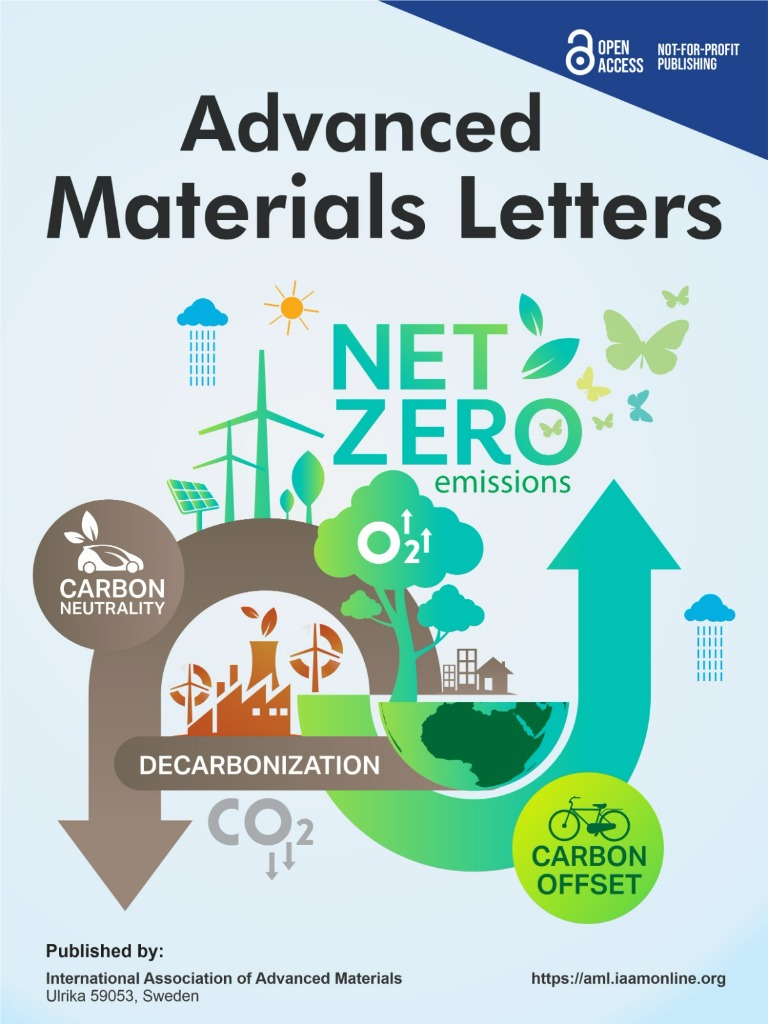
Aims & Scope
Advanced Materials Letters serves as a premier platform for cutting-edge research in materials science, engineering, and nanotechnology.
Journal Scope & Mission
Advanced Materials Letters (AML) is committed to publishing high-quality, original research that advances the fundamental understanding and practical application of materials science. Our scope encompasses the entire spectrum of materials research, from fundamental studies to applied engineering solutions.
The journal welcomes contributions that demonstrate significant innovation in materials synthesis, characterization, processing, and applications. We particularly encourage submissions that bridge the gap between laboratory research and real-world applications, fostering technological advancement and industrial development.
AML aims to be a global forum for researchers, scientists, and engineers to share breakthrough discoveries, novel methodologies, and emerging trends in materials science, supporting the advancement of sustainable technologies and next-generation materials.
Core Research Areas
Nanomaterials & Nanotechnology
Synthesis, characterization, and applications of nanostructured materials including nanoparticles, nanowires, nanotubes, quantum dots, and nanocomposites.
Biomaterials & Bioengineering
Biocompatible materials, tissue engineering scaffolds, drug delivery systems, biosensors, and materials for medical applications.
Energy Materials
Materials for energy storage and conversion including batteries, fuel cells, solar cells, thermoelectrics, and supercapacitors.
Electronic & Photonic Materials
Semiconductors, conductors, dielectrics, magnetic materials, optical materials, and materials for electronic devices.
Submission Criteria
AML welcomes original research contributions that meet our standards for scientific rigor and innovation. All submissions undergo rigorous peer review to ensure quality and significance.
Material Categories
Advanced Ceramics
Polymers & Composites
Metals & Alloys
2D Materials
Application Domains
Key Techniques
Special Features & Focus Areas
Sustainable MaterialsFeatured
Research on environmentally friendly materials, recycling technologies, and circular economy approaches.
AI-Driven Materials DiscoveryFeatured
Machine learning applications in materials design, high-throughput screening, and predictive modeling.
Smart & Responsive Materials
Self-healing materials, shape-memory alloys, and stimuli-responsive polymers.
Quantum Materials
Materials with quantum properties for next-generation electronics and computing applications.
Multifunctional Materials
Materials combining multiple properties such as structural and functional characteristics.
Industry 4.0 Materials
Advanced materials for additive manufacturing, IoT sensors, and smart manufacturing.